
My Pots Boileth Over: The Case for Multiple Projects
by Joe Baumann
Like most writers I know, I am met with the question, “What is your writing process?” with some regularity; it’s a popular ask during interviews, Q&A sessions, and the like. It’s a perfectly fine question: readers who aren’t writers want to get a behind-the-scenes look at how artists work their craft; aspiring writers are looking for insights into how to make themselves and their own relationship with writing better. But whenever I receive the question, I balk, briefly, not because I don’t have a process—every writer does, even if that process is to follow no discernible pattern or rhythm with their writing—but because, when I start explaining my approach to tackling projects and ideas, I know I sound a little bit kooky.
There is an endless supply of writers who have written and talked about their writing processes. So rather than unpack all of the things that I do when I sit down to write, I am going to focus on one habit only, the one that gets the most eye-raises: my practice of working on multiple projects at once.
When I say multiple, by the way, I don’t mean two. I generally don’t mean three. At the risk of really sounding like I belong in an insane asylum, I also don’t mean four.
That’s right: I am often working on upwards of five projects or more, all at once. I’m not talking about drafting one project, revising another (or two), outlining something else, submitting another to an editor or agent or press. No: to be clear, I mean the in-the-trenches, writing-a-rough-draft of nearly (or, if I’m feeling particularly out of my mind, more than) half a dozen ideas at once. You might be imagining one of those old-timey circus performers balanced on a bicycle with one gigantic wheel, holding up too many poles on which spin fragile plates. You wouldn’t be entirely wrong.
So the question, of course, is why.
As a personal aside—and reason—I will mention that I generally have a hard time focusing on a single writing project for long stretches of time in a single sitting. I discovered long ago that forcing myself to sit down and knock out five, six pages, or some set count of, say, a thousand words, for a single story or novel (or whatever) was not a productive approach for me as a writer. I burned out too quickly. My creative focus and juices (and ideas, perhaps) fizzling before I could hit the benchmarks and goals I set for myself. However, when I changed my approach, to focus on a few different things in a given day, perhaps writing a page or two of each thing I was working on, I found myself, and my work, and my productivity, flourishing.
Soon enough, I found myself working on multiple projects on purpose, adding another, and another, and another, before I finished with the ones already in process.
I’m not entirely alone in my approach here, either. One of my favorite writers, George Saunders, when asked about his process at public readings (which is where I heard him say this, so no fancy citation or direct quote forthcoming), talks about being a “many pots on the stove” writer. He says that he likes to be able to move from one project to another seamlessly, jumping from one world to another. This, he says, helps keep creative slumps at bay: if one idea starts to sputter, he can immediately switch to another and find that spirit again. I haven’t asked him in the three times I’ve seen him live how many pots he likes to have on his metaphorical stove, but the point remains: if George Saunders is into it, it’s hard to suggest it’s bad practice.
Another excellent supporter of this approach is Chilean writer Roberto Bolaño. In his “Advice on the Art of Writing Short Stories,” he leads off with, “Never approach short stories one at a time. If one approaches short stories one at a time, one can quite honestly be writing the same short story until one dies.” He goes on to say, “It is best to write short stories three or five at a time. If one has the energy, write them nine or fifteen at a time.”
I will admit I’ve never had the energy for writing nine or fifteen at a time. But otherwise: I’m with you, Roberto! I think of creative production this way: let us imagine I’m working on a single piece of writing, pouring all of my focus and imaginative energy into it and only it, and I come to the inevitable moment where I feel I’ve either backed myself into a corner, or I’ve lost sense of the focus, or I quite literally do not know what should happen next, and I sputter out. I can’t put words to the page. I simply don’t know what to do. The impulse, I would argue, is more powerfully felt to stop writing, to throw one’s hands in the air and let the piece fall aside to the graveyard where what seemed like good ideas go to die (or at least languish), if it’s the only thing one is working on. After all, if the one project stalls out, what else is there besides the wracking feeling of not having any output or ideas?
But halt! This is where those other projects come in. If a writer is suffering the above scenario but has other work to turn to, this creates other creative avenues for exploration. I have almost never (possibly absolutely never) found myself staring at four or five projects where I had absolutely no clue what to do next for any of them; as such, I almost never (again: possibly absolutely never) find myself with no avenue for creative output. And more often than not, if I am stuck on one project and redirect myself to one of the several others, I eventually, in the process of working through those other pieces, find something that sparks a re-revving of the engine of the stalled-out project. As such, I’m able to sustain and continue to produce creatively without suffering the dreaded writer’s block or dearth of ideas.
So it may seem crazy to embark on multiple—three, four, five, more!—projects at the same time. But if you’re currently a one-project writer, I encourage you to give juggling multiple ideas at once a try. I’m willing to bet that, more often than not, you’ll find yourself not stretched too thin but instead swelling with abundance: options, opportunities, ideas, output. Your cup, like mine, will floweth over.
AUTHOR BIO
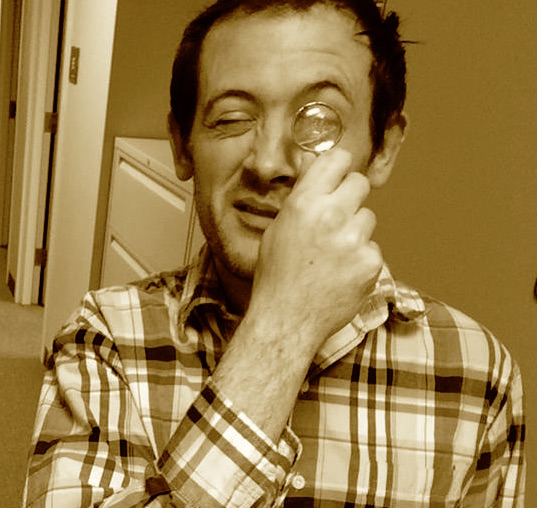
Joe Baumann is the author of three collections of short fiction, Sing With Me at the Edge of Paradise, The Plagues, and Hot Lips, and the YA novel I Know You’re Out There Somewhere, as well as the forthcoming collection Where Can I Take You When There’s Nowhere to Go and novel Lake, Drive. His fiction and essays have appeared in Third Coast, Passages North, Phantom Drift, and many others. He possesses a PhD in English from the University of Louisiana-Lafayette. He was a 2019 Lambda Literary Fellow in Fiction. He can be reached at joebaumann.wordpress.com.


 Angry Gable Press