Inside, Outside: Managing Story Balance in Four Parts
By Joe Baumann
Writing is hard. It goes, perhaps, without saying, but when teaching writing, I find myself saying it a lot. Writing is also fun, or should be, but when it comes to crafting a complete, complex work of art, there’s a lot to balance. In writing fiction, in particular, one has to strum up a compelling plot with compelling characters, have some sort of thematic intention, and tell the story using vivid, vibrant, purposeful language. And one has to do it using the right point of view, the right syntax and style, the right pace, the right verb tense, etcetera, etcetera. And in any good story, the things that happen externally to the characters are working in concert with the things happening to them internally. There needs to be a balance between showing and telling, between action and description, between scene and summary.
It’s a lot to manage.
When I read short stories—my own, students’, the many that have been submitted to my literary magazine—I often find that a significant issue is the balance between interiority and externality, the shifting sands of plot—tangible events unfolding on the page—and character—what is going on beneath the surface, sometimes untold—and how the two work together. Usually, if a story has a fundamental problem, it’s either an over-reliance on plot, resulting in an uneven, threadbare internal current, or the opposite: too much interiority, with nothing concrete for readers to map the characters’ experience(s) onto.
As part of my own process for avoiding this imbalance, I have adopted what I call my four-part structure to fiction (which is, arguably, also applicable to other forms). That structure’s parts are premise, plot, story, and theme.
Let’s begin with premise and plot. These I think of as the external components of a piece of fiction. Premise is the “what circumstances surround our story and its world.” In Shirley Jackson’s “The Lottery,” the premise would be something like, “A small town gathers in its square to select a person to stone to death each year.” In The Lord of the Rings, the premise is “A hobbit and his friends set out to get the One Ring to Mordor.” This may sound like I’m describing the inciting event of the story, and in a way I am: the premise is often tied to what kicks off the action, but it also includes any parameters of the world in which the story takes place. In Aimee Bender’s “The Rememberer,” for example, the premise would be “the narrator’s romantic partner experiences reverse evolution.”
Plot is fairly simple: the events that actually occur within the story. You might imagine it as all of the events that encompass the story, whether they appear on the page or not (if a character mentions the deaths of their parents ten years ago, for example, even though we don’t see a scene of those deaths, they would still be part of the plot). You can also imagine plot as the scenes that actually unfold on the page for readers, the present as it spins out in narrative.
These are the pieces that a reader experiences tangibly. These are important—but they’re not the only important parts. The internal is also key. So let’s turn to story and theme.
Admittedly, talking about “story” as a component of, well, a story may be confusing. Like the word genre—which can refer both to form (poetry, fiction, etc.) as well as content within form (science fiction, realism, etc.)—I utilize the word story in two ways. Its broader definition is simply “a text that includes a narrative,” which refers to all good poems, short stories, novels, personal essays, etcetera: they all have a story. In the context of our four-part structure, I define story as the significance of included events. Story is related to plot, but on the other side of the external-internal coin: while plot is literally the events that occur, story is the reason that they matter to the characters who experience them.
The final part is theme, a word most of us have encountered before. For some, the word evokes a lesson or moral that a story or poem or essay wants to impart. And this may be true—some stories are didactic, like the allegories of many American Romantics or Aesop’s famous fables, which certainly aim to impart insights and guidance. In contemporary writing, such overt moral imperatives have generally fallen out of favor: today’s readers don’t want to be told what to believe or think or feel. So instead, I think of theme as the way that a writer is exploring or answering the question What does it mean to be a human being? Seeing and thinking about this question may require some intellectual flexibility. The notion of being human, here, is anything that explores or ruminates on any aspect of the human condition or experience: how we grieve; what it means to seek connection; how we forge our identities; what the tribulations and traumas of anger, pain, loss, fear, are—the list goes on. Anything that taps into or explores a part of the human experience falls within the umbrella of this question.
So there you have it: the four “components” that I envision and try to sort out when I am writing a story. But how do I go about combining and approaching them?
Managing every piece of the writing puzzle and process, especially at once, is incredibly difficult; some (myself included) argue that it is, in fact, impossible. And so, when I am writing, I don’t try to handle them at once. I am an exploratory writer, meaning that I rarely outline; instead of having a clear charted path for the entirety of a project from the outset, I usually have only a tiny kernel from which I expand, discovering components along the way. For me, this kernel is more often than not a premise—an image or idea that I capture in an opening sentence that serves to frame the potential story. If I were so fortunate as to have come up with the idea for “The Lottery,” I may have only known I wanted to write about a town in which one person is stoned to death every year. I may have had no idea what specific events would be depicted in the story, or what I was trying to say thematically, or why this event mattered (aside from potential death) to the characters—I may not have had a sense of who the characters would be. But I would have taken my premise and started writing, learning these pieces along the way.
This isn’t to say that I wouldn’t have the other three components in the back of my mind. Most often, as I am bumbling through the unmapped territory of a story idea, I have the questions related to story and theme percolating in the back of my mind; while I am happy to wander wherever events take me in a draft, I am thinking about which of the events I’ve put to page are important, both to the plot and to the characters experiencing them, why I’ve chosen these events and moments rather than others, and how they are going to add up to some thematic sensibility—eventually. This word is key: eventually. Things do not need to be clear to me from the start, or halfway through, or even twenty pages in. I have faith in myself that, eventually, I will stumble across a line that I will write, whether it is dialogue or action or a thought or description, that will resonate across premise and plot and into story and theme, an ah ha moment that reveals to me the heart of the story and thus its thematic drive.
It’s important to remember that no one—except maybe one or two writers, whom, as Anne Lamott says, we do not like very much—can tackle all of these things in one fell swoop and get them to work together, perfectly, from the outset. And so getting all of these things to hinge with one another in the right way is a wandering, pretzeled process that involves a lot of guess-test-and-revise, then revise some more. But by breaking your story down into these four components to keep in mind, you may find yourself having at least a bit of an easier time, a clearer map to follow as you chart your way forward into creativity’s unknown.
AUTHOR BIO
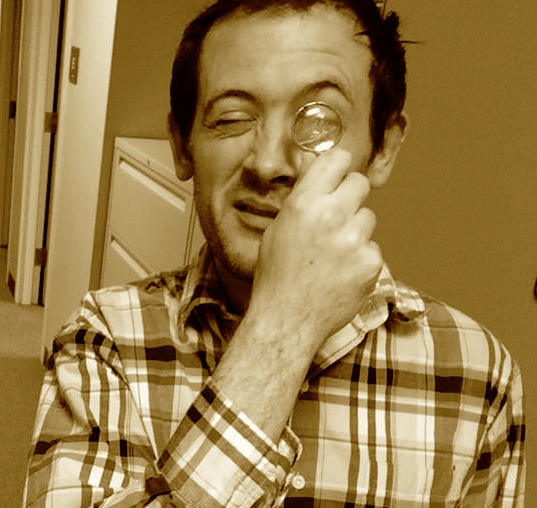
Joe Baumann is the author of five collections of short fiction, most recently Tell Me, from Curbstone/ Northwestern University Press, and the novels I Know You’re Out There Somewhere and Lake, Drive. His fiction and essays have appeared in Third Coast, Passages North, Phantom Drift, and many others. He possesses a PhD in English from the University of Louisiana-Lafayette. He was a 2019 Lambda Literary Fellow in Fiction. He can be reached at joebaumann.wordpress.com.