Speculative Poetry and The Plasticity of Form
By Michael Hessel-Mial
Alexander Freed’s novelization of Rogue One has a fine practice of including interesting primary sources to illustrate the world of Star Wars. There are reflections from Mon Mothma on rebel military doctrine, plus fun irritable turf war correspondence between Tarkin and Krennic. It also has the following poem, a prayer attributed to the Guardians of the Whills from the Jedi temple at Jedha. It reads:
In darkness, cold.
In light, cold.
The old sun brings no heat.
But there is heat in breath and life.
In life, there is the Force.
In the Force, there is life.
And the Force is eternal.
When I first read it, I remember feeling disappointed that the poem did so little to really create and play with the poetics of another planet. Stylistically, it follows cues from two sacred text traditions: the paradoxes of the Daodejing and the grammatical parallels of the Hebrew psalms. I can’t imagine these elements were employed with a lot of thought; rather, it’s more likely Freed thought vaguely about what a sacred text should sound like, then dashed these lines off in a few minutes. There’s room for culturally specific figurative language: the Psalmist’s odd plant and musical instrument similes or Laozi’s unexpected metaphors of dogs and babies. Reading the Jedha prayer, I kept thinking about how much more it could be. (I hope I didn’t just derail my dream of writing Star Wars tie-in novels and poetry. Hire me!)
To draw in a contrasting older example, Tolkien’s “The Stone Troll” (sung by Sam Gamgee on seeing Bilbo’s old solidified trolls) is a really creative use of invented form that tells us something about hobbits. Here’s the opening stanza:
Troll sat alone on his seat of stone,
And munched and mumbled a bare old bone;
For many a year he had gnawed it near,
For meat was hard to come by.
Done by! Gum by!
In a cave in the hills he dwelt alone,
And meat was hard to come by.
The repeated rhyming refrain establishes it as song, the rhyming nonsense phrases mark it as an oral improvisation, and the story type establishes a playful relationship with the common knowledge of the past. We learn as much from hobbit culture through the structure of the poem as we do from a paragraph about their eating habits! Tolkien isn’t always so creative with form; much of the time his in-universe poems have a recognizable rhyme and meter in the Victorian vein that he likely grew up on. But one commonality is that they avoid the ‘literary’-sounding iambic pentameter, choosing meters that sound just a little folkier. These choices tell us something about who these different poets are supposed to be in Tolkien’s world.
Sometimes reading speculative poetry, whether it’s world-building extracts included in novels or standalone speculative poetry works, I feel like there’s room for just one more step into thinking about poetic form more consciously, more completely. Now, speculative poets love form. When reviewing submissions for Specpoverse, which I co-edit Miguel Mitchell (I speak only for myself in this essay), I see all sorts of things: sonnets, rondeaus, concrete poetry, image macros, and of course many scifaiku. Most of the time, the distance between the form and the world of the poem allows for a play, critique or reinvention of the genre conventions. Other times, speculative poetry leaves questions of form to the side, focusing on well-crafted free verse to keep the attention on the speculative elements as the speaker sees them. Personally, I’m very drawn to invented forms, and so this column is about how we can understand the role of form in speculative poetry.
I’m committed to an idea of speculative poetry, and speculative fiction more broadly, that takes two insights very seriously. The first is that poetic form is fundamentally plastic (the old-school definition of plastic is “shapeable”). There is an infinite variety of ways to make poetry magic happen, in dialogue with so many literary histories and cultures on our planet. I’d love to see more people really take that infinite possibility to heart. The second is that playing with form can be a vehicle for world-building. Decisions about what a line should sound like, or what kind of register the poem should be in, what kind of content is considered appropriate for the form, all say something about the character and the world they reside in. Now, there are two things about my approach to speculative poetry that make these principles more important. First is that my poetry assumes 1) a distinct invented world, in which 2) a character has written the poetry in question. Speculative poetry doesn’t always assume this, which is good. But if you do make this assumption, some really cool things can happen.
Poetry can be anything. Repeat your consonants in a line and you have alliteration. Forbid yourself from using a certain letter and you have a lipogram. Put words together into a massive compound and you have the climax of some Telugu poems (as well as James Joyce’s “thunderclap”). Write only about absence and you have an apostrophe. Put your poems in the shape of what you’re depicting and you have a calligram. Write a three-line poem with a restricted number of syllables and you have a haiku. Write a sequence of sentences that alternate between additive and subtractive poetic rules, ending with a sentence telling readers that you’ve done it, and you have this paragraph.
Making my start in mostly American-European poetry traditions, I was strongly influenced (like many others) by 19th- and 20th-century verse revolutions: free verse, automatic writing, chance operations, found poetry, sound poetry. Such developments were premised on the wide possibilities of poetry. And from them I also got a sense of language as “stuff,” a kind of material you could produce and shape, not ignoring the meaning of the words but by dramatically reshaping them, add or subvert meaning. But I also suspected that the global trajectory toward a more narrowed range of modernist aesthetics might also be a colonialism in verse, dismissing or forgetting other world poetry forms. But all the world’s poetry traditions have their own ways of negotiating the infinity of poetic forms. Kabbalistic poetry cuts up, repeats and stutters phrases just like Gertrude Stein or Kurt Schwitters. The deceptively familiar haiku is itself a breaking up of the formal haikai no renga collaborative verse tradition. Chukwuma Ozuonye’s research on Igbo oral epic (in conversation with the bards Kaalu Igirigiri and Ogba Kaalu) shows this oral tradition in constant debate about minimalism and embellishment as competing vehicles for expressing historical truth. All this is to say that not only has poetry always been plastic, but I think all around the world people have realized it. Whatever our relationship with form—whatever slice of language’s infinite we choose—we should really care for it with responsibility and love.
My insistence on the plasticity of form is also in contrast to a prevailing idea about form: that it be ‘natural’ to the language or rooted in everyday experience. For example, part of the appeal for writers involved in the alliterative poetry revival (which has a lot of speculative poets) is that alliterative poetry fits the rhythms of the English language. Similarly, speculative poet Frederick Turner (via email correspondence a few years back) argued that pentameter was an especially natural form for the English language. As for me, I can see the appeal in stressing organic form, but I’m also suspicious of it. No doubt that some forms are easier in some languages, but I believe that poetry’s plasticity, capacity to always be reinvented, is an essential piece of the story. It certainly feels most relevant to speculative poetry; to invent forms is appropriate for invented worlds.
Which brings me to the other key principle, that poetic form is a kind of worldbuilding. To make a decision about how fictional people make special arrangements of words is to say something about culture and history. The choice of how to arrange words is always arbitrary, but once made there are available palettes of expression. Does the form favor a burst of rhetoric and passion, or does it favor a few precisely-chosen words? Does the form appear in a ritual or celebratory context? Or a festive, ribald one? Does the culture in this world have a primarily oral literature, an elite or enclosed literary tradition with set canon/tropes, or a widespread literate population open to varied self-expression?
In a speculative world, an intentionally chosen form can reveal things about that world, because a form implies its history. Let’s take the real-world sonnet as an example. The sonnet compacted and streamlined the florid songs of the troubadours to become a vehicle for rationalistic self-construction, and with it the poem’s ‘others’; if you pay the right attention, you can read patriarchy and orientalism into the sonnet’s subjects. A form favors certain kinds of cognition that are bound up in the prevailing ideologies of the moment. On the flip side, poets sometimes reveal social tensions in their relationship to forms. As a prestige form, poets from marginalized backgrounds have reimagined the sonnet, sometimes changing the form to both comment on its history of exclusion and open it to new sounds. Another way of saying it, is that forms imply cultural meanings that are also points of conflict.
In some of my speculative poems, I’ve practiced depicting how a poet might both embrace and contend with an invented, in-universe form. In “The Restored Cataract,” appearing in State of Matter, a poet from the group called ‘drivers’ begins in a restrictive prestige rhythm (Xxx Xx _ xX xxX for those who want to try it), before switching to a traditional driver verse form, in a poem that pushes against the interstellar colonialism of this world. In another poem, “Transmission Guidelines” (currently unpublished), the working class poet uses the prestige form of “mirror rhyme” to contrast their own argot for workplace accidents, with the euphemistic language of the upper classes they work for. In thinking about the form’s history and internal tensions, there is a lot of opportunity for the poem’s world to better come to life.
For my particular universe, the invention of forms has accompanied the writing of a larger narrative epic, with its own specific meter and added-in other poetic forms to contrast different understandings of history and society. I might just really like inventing new forms, but I also see in the exercise a chance to better understand these different people, just like how understanding world poetry helps better understand our own world. So far I’ve stumbled onto a funerary chant, a meter used by sentient computers, a popular song structure with some genetic similarity to a hymn form, one culture’s creative use of syntactical rhymes, two different sonic rhyme patterns, four or five oral traditions, and an alliterative poetry tradition used by the far-future equivalent of communists. It’s kept me pretty busy!
Among the infinite number of fiction writing guides out there, I see lots of little pearls like “to explain how something works, depict someone fixing it.” Maybe one takeaway from this piece is something like, “to flesh out the social world of the story, have a character write in an invented poetry form they don’t like.” That could do something! But there’s also more specific political and intellectual significance I have attached to this practice. Poetic forms imply cognitive modes, social organization, and conflicting ideologies. To work in invented speculative forms is to think about thinking, place oneself in intellectual history. This task is not separate from the political work of figuring out how we should relate to one another, how we should create society. In a small way, the work of fighting fascism and making sure nobody goes hungry has at least one side quest through language, and the insight that poetry can truly be anything. The real implication of the plasticity of form is our ability to make and remake our relations with one another.
Postscript:
I’m sharing this way that I write poems, partly to provoke and challenge people to think about their poetry practices in new ways. But there’s one misunderstanding of these ideas I want to bring up in order to shut it down. It’s the very common idea that restrictions or firm structure are necessary for poetry. The idea is often expressed this way: “no fair tennis without a net.” However, I love tennis without nets, football with jetpacks and soccer with enchanted sentient falcons. We’re doing speculative poetry, after all! So if I’m talking about form, it’s about possibility for things that might enrich one’s poetry. If these ideas are interesting for you, try them. If you’re doing something different and want to keep at it, do so.
AUTHOR BIO
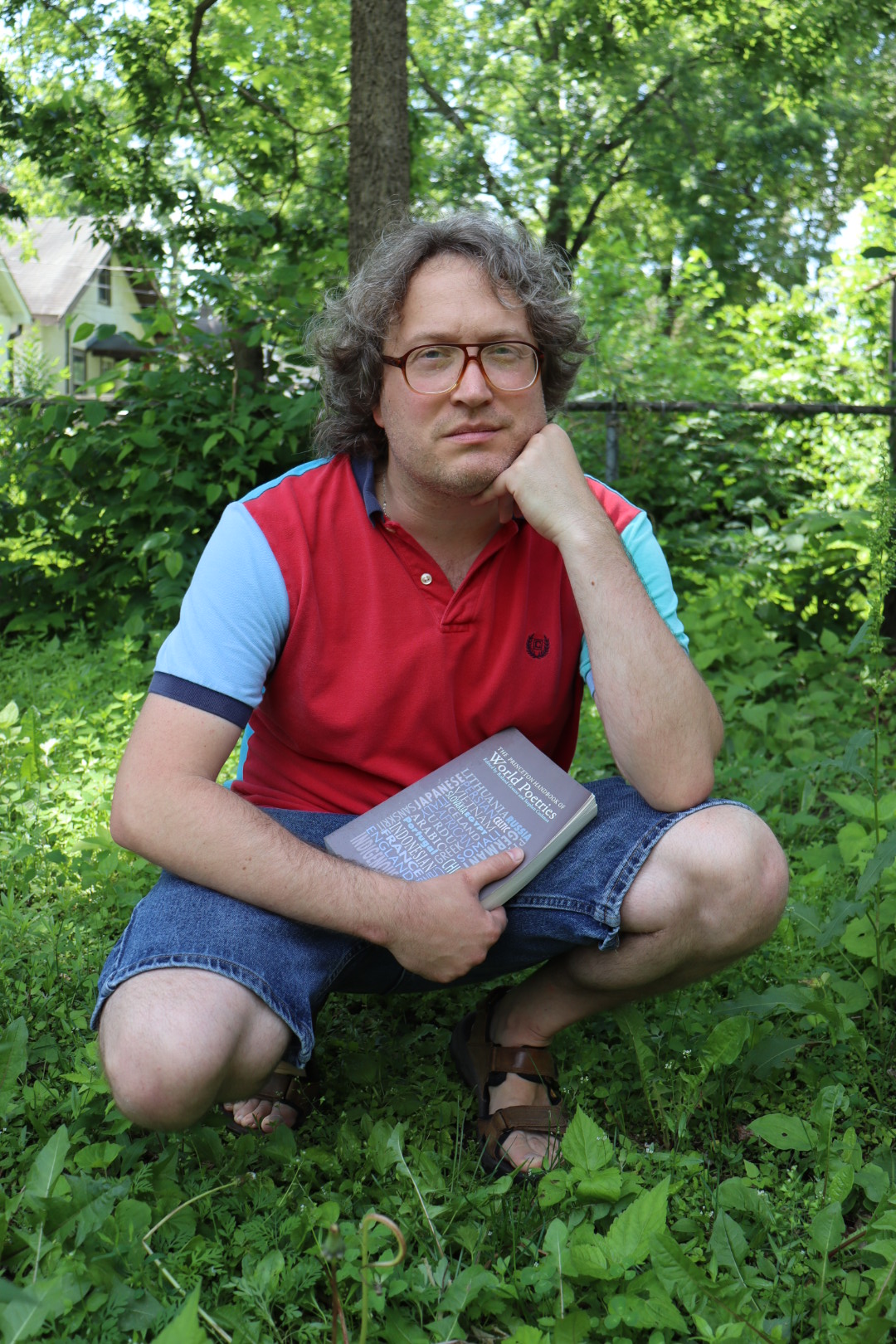
Michael Hessel-Mial (he/him) teaches writing at the University of Minnesota. His speculative poetry draws on world poetry traditions and histories of social struggle. Similar work can be found in The Deadlands, Forgotten Ground Regained, and State of Matter. Michael’s older digital poetry work has also appeared in Columbia Journal, The Fanzine, and Queen Mob’s Tea House. Michael edits, with Miguel Mitchell, Specpoverse Magazine. Michael is Jewish and a father. He believes in unions, prison abolition, and a free Palestine. He’s writing a science fiction epic poem called Song of the Participants. You can find him by the handle @mrpoemguy on Substack and Bluesky.


 Angry Gable Press