
Behind the Poem: Scoring Performance 9
By Michael Hessel-Mial
Published April 7, 2026
Welcome to Behind the Poem: Angry Gable edition!
This year, I’ve been doing write-ups about recently published poems over on my Substack (like this essay about this poem up in The Deadlands). Along with the honor of having three poems appear in the second volume of Katabatic Circus, Angry Gable Press graciously offered to host the “Behind the Poem” essays for those poems. I’m glad to get to share more about my work with you!
Before I begin writing about the first poem, “Scoring Performance 9,” I’d like to share more about my rationale for these essays. There’s a widespread belief that explaining a work of art either weakens its power or proves that the work wasn’t successful. There’s some truth to that, especially if all the explanation does is inform readers of what trivia they must know in order to ‘get it.’ On the other hand, sharing a ideas about creative process or theory can not only enrich the engagement with one work, but also engagement with other works as well. The model for essays like these is less about surface and depth, where certain information gives access to the work beyond the surface. Instead it’s about genesis and totality, whereby knowing how a work came into being gives a sense of how all the elements come together.
All works of literature teach their reader how to read them. These poems I’m offering, as works of a fictional literary history in a created science fiction universe, are meant to reveal something about the relationship between literature and politics in our own world. The poetry we canonize says a lot about empires, capital, and the identities we privilege over others. Reading the broad span of world literature, it is possible to see these tensions at work, in the implied point of view or ‘stance’ of the poet to what they write about.
“Scoring Performance 9,” written by Regolith Crossing some 800-900 years from now, is a more explicit example of the relationship between poetic form, the stance of the poet, and political power. It is modeled after epinikia, the Greek victory odes written after athletic contests like the Pythian or Olympian games (which became the present-day Olympics). On the surface, such poems read as majestic celebrations of physical skill, with lengthy asides on mythical subjects and no shortage of poets boasting of their own skill. They’re fun and beautiful to read for those elements. But epinikia are also some of the earliest examples of literary patronage, sponsored by aristocrats and tyrants. A more careful reading of these poems makes that propagandistic purpose for writing so obvious as to almost ruin the poetry experience. Before going into more detail on that, I’d like to first get into what went into this poem in the first place: the conventions of epinikia and the lived world of its far-future equivalent.
What kinds of sports will people play in the future? It’s worth remembering that while measures of points, pounds lifted and seconds of swim time might be purely rational, there’s always an element of culture and meaning in organized play. Sport always has an element that represents some aspect of the broader social world. Most professional sport as we know it is modeled on warfare, with its contested territory, offense and defense. The way rules are decided reflects what we value in the sport; for example, the placement of the three-point line in basketball determines whether coaches prioritize team collaboration or the shooting skill of a few star players. The kind of sport we value also depends on the technological milieu, from something as small as the production process for particular kinds of balls to the media apparatus for viewing the sport. Aesthetic trick-driven sports like skateboarding or BMX, which originated in unapproved skating on public infrastructure, could circulate more easily with widespread home video recording independent of big stadiums or media networks.
The far-future sport “Limb-and-Payload” is based on two unexamined assumptions about sport. First, that sport takes place in space, played in microgravity with contending teams interacting in scored flight formations. Second, that play includes a networked component, where teams assemble electronic modules that interact with opponents’ own assemblies, as a scored component alongside physical play. If we primitive planetbound can only imagine sport as taking place with a ball maneuvered by unnetworked humans on the flat surface of a planet, then the above two assumptions are canonically what sports are for most people in the settled parts of known space. More particular to “Scoring Performance 9,” the sport is held to have some relevance to military virtues, and the poem spends some time on those virtues (which we readers are not expected to necessarily share).
In writing the literary history of this sci fi universe, I would eventually come to create more poetic forms whole cloth. Here, I follow pretty closely to the conventions of the epinikia form. Here are some things you can expect of it. First, it’s an early example of poetry supported by a patron. Political figures, especially tyrants, sponsored epinikia about contests they themselves or their relatives competed in. Epinikia often follows what’s called a ring structure, with topics embedded in the poem like nesting dolls. The subject order is something like this: A, B, C, C’, B’, A’. The A subject opens with an account of the actual contest, alongside praise for the sponsor, and self-praise of the poet’s skill. Then, depending on the length and complexity of the poem, the poet will turn to one or more mythic subjects that tie into a common theme. These myths are retellings that sometimes deviate from widely-known source material. By the middle length the poet will go through the established subjects in reverse order, tying things together in a grand finish.
There’s this tension in epinikia, which are so beautifully written and yet so compromised by their naked service to money and power. It ended up being one of my first concrete lessons in reading politics through the poetic form of more culturally remote works. I learned two things. When a reader encounters lines that beautifully capture some ‘timeless’ wisdom, to look for an underlying conservative impulse in them. Pindar’s first Olympian ode announces that the golden sun is superior to the gold of riches, which someone could optimistically read as some early anti-capitalist ethos. It is not; Pindar still took his paycheck from the tyrant Hieron of Syracuse. The assertion of the sun’s primacy is a statement of faith in hierarchies and one’s place in them. Across this Greek lyric tradition is an apparent voice of skepticism about wealth and power; but looking closer it becomes clearer that these are poems written by and for wealthy men, and these statements are just exhorting readers/listeners to wield power with a steady hand. That buried conservatism was the first lesson.
I learned another lesson from closer study of epinikia, which is relevant to many genres of poetry. It’s the way the poem talks about the art of poetry as a whole. Epinikia of Pindar and Bacchylides, and precursor epigrams of Simonides, refer to the art of poetry, specifically the poem’s ability to confer immortality to its subjects, and the poet’s unique skill (a moment of self-advertisement) in making poetry do that. Now, to set up why this matters, I should describe a poetry pet peeve that has always bugged me. The place I went to grad school had a strong contingent of very affluent devotees to a very traditional Euro-Anglo vision of poetry. For them, poetry was a timeless activity that still tended to favor certain languages, emotions, and people over others. I’d often hear people say banal truisms like “poetry is always about itself”; not in a cool deconstructive sense, but rather that poetry is always in a self-conscious dialogue with ‘The’ poetry tradition. That idea always bothered me, because it seemed so detached from the many ways people have made and engaged with verse. Realizing that Pindar’s glorious metapoetry was a rhetorical feature of its rootedness in power, I felt like I finally had an answer to this ahistorical sense of poetry tradition I’ve often encountered. Poetry certainly can awaken this creative sense of language talking to itself, but this sense varies across equally valid forms poetry can take, and has to be considered alongside the social milieu of the poet.
Now, to “Scoring Performance 9” once again. If there’s a single passage that I hope gives away the limitations of the speaker’s worldview, it’s this one: “It is better to hold steadfast to willed uncertainty / than surrender unvirtuously to ridicule for one’s passion.” Regolith Crosser describes a “clockwork god” (historical figure associated with early spaceflight turned figure of myth), Grazing-from-the-Tree, who even in myth is recognized as having doomed human’s planet of origin. Like Pindar, the poet revises the myth to better suit the taste of her audience. That two-line justification asserts that it is better to feign ignorance than to care too earnestly about something. I see that affect underlying a lot of reactionary views, which must pretend true things are uncertain in order to affect a posture of reasonable skepticism, rather than the hidden fanaticism it actually is. When the idea is expressed in plain language, its hideousness is transparent; when expressed in a different kind of language, it becomes ‘timeless’ wisdom.
As the poem’s closing lines express, limb-and-payload is as much a martial art as it is a standalone sport. Regolith Crosser laments that the military prowess of her society has (in her view) given way to less virtuous pastimes, and her poem hopes for a realignment toward planetary conquest. My sci fi universe, which is full of contested history and often-suppressed bottom-up movements, is premised on the idea that the initial centuries of spaceflight were mostly led by the terrible ilk of Elon Musk and other tech fascists (I believe in other futures, but this universe explores that one direction). Of the poems in this fictional far-future poetry anthology, ancient ones like “Scoring Performance 9” still have the most direct stamp of the tech fascist ethos. I think, at the end of it, this poem is really about the tension between some classical poetry’s beautiful rhetoric and the relations of domination it openly or covertly celebrates. What I hope readers can take away is a practice for reading that tension.
AUTHOR BIO
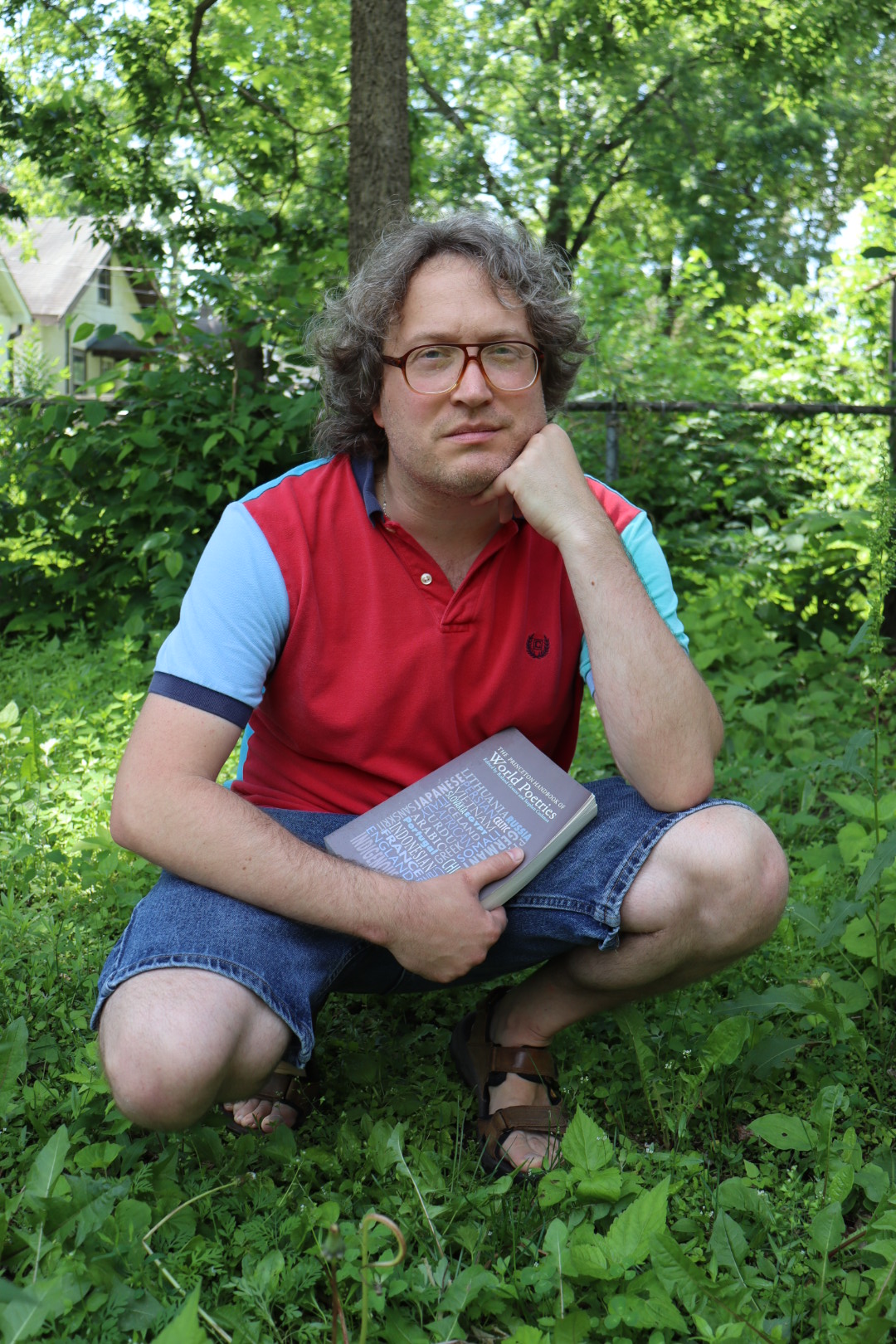
Michael is a poet and scholar based in Minneapolis, where he teaches university writing. A comparative literature PhD, Michael builds far-future literary histories to explore how poets resist or negotiate capitalism, racism, patriarchy, and ecocide. Michael is co-editor, with Miguel Mitchell, of Specpoverse. He is also Jewish and a father. Along with his work in Katabatic Circus, you can find his speculative poetry in Utopia Science Fiction, The Deadlands, Forgotten Ground Regained, and elsewhere.

 Angry Gable Press