Behind the Poem: Stepwise Proof by Side Route
By Michael Hessel-Mial
Published June 29, 2026
Welcome back to Behind the Poem: Angry Gable edition!
Like last time, I’m leaving my usual substack haunt to bring my reflections on poetry to Angry Gable Press readers. If you’re new to this column, I write speculative poetry as entries of a far-future literary anthology. Behind each poem’s exotic form or strange content is a reflection of our own world literary history, and with it, the social struggles that poetry gives voice to. My “Behind the Poem” essays are a chance for me to explore the poetics, world-building, and politics I was thinking about as I wrote a given poem. Since I have three poems in the fabulous Katabatic Circus, Vol. 2, the editors were kind enough to give me space in the Angry Gable column!
This last column is about “Stepwise Proof by Side Route,” attributed to Dual Announcer. This is the most “recent” poem of the three poems and reflects a sensibility closest to the “present” of the secondary world (this poem is about four thousand years into the future). Like with many of the poems I wrote in 2024-2025, I set a few dozen “parameters” and randomly selected a handful of them to spark the main idea for the poem. For this poem, the chosen parameters were “Planetborn, high modernism, starborn, song lyrics.” What that meant was that the poem had to be high modernist poetry (peak abstraction in the early 20th-century vein), straddle upper and middle class sensibilities, and incorporate song lyrics in some way. The immediate choice for me was the looming patriarch of verse: T.S. Eliot. I had to, in some way, devise what the “T.S. Eliot of the far future” would look like, for better and for worse. Because capturing Eliot’s flaws is a part of the whole mission.
Beyond the challenge of doing a satisfying ‘style parody’ of a famous poet, what I was interested in here was similar to what I raised in the first column: how the poet’s “stance,” or general position to view the world, works along with their chosen form to shape the political role the poem can play. Eliot is especially interesting here, as someone who is both formally innovative and also deeply conservative. The end result gave me some insight into the politics of high modernism, and also led to some really useful world-building for me in general.
Eliot has been placed on such a high pedestal that I feel an almost instinctive need to knock the pedestal down. As I’ve seen it, the great diversity of modernist poetry/art movements is subordinated to Eliot, as if he invented everything, and as if tracking down his allusions was the peak of engaging poetry. Affluent poetry publics often reinforce this reading of Eliot, and today conservative poetry fans champion Eliot as a force against contemporary ‘disorder.’ When I teach modernist poetry, however, I usually teach other figures and movements instead (like Stéphane Mallarmé or the Harlem Renaissance poets), because I believe it’s a more accurate and open picture of the 20th century’s first few decades of poetry.
But taking on the rereading to construct this poem, I remembered that I do have a relationship with Eliot. Though I did spend some time with “The Waste Land,” and consulted a few articles refreshing me on Eliot’s background/reception, most of my efforts for this poem were spent rereading Four Quartets, his last book-length poetry work (and, to me, the most his own, without influence by other writers like Ezra Pound). I noted as many of the unique little features of Eliot’s voice that I could, which I’ll go through in the next paragraph. And in doing so, I have to admit that Four Quartets has countless incredible lines that I’d actually remembered from first reading it close to two decades before. There’s a lot of bangers along with the baggage.
So, what would it take to make an Eliot poem? The first and most obvious one is rapidly changing poetic registers from stanza to stanza. Many Eliot poems will include some of the following: free verse, scattered iambic pentameter lines, random song lyrics (or stanzas in a song structure), quasi-medieval language, and repurposed sentences lifted from religious/philosophical texts. If there’s anything to really appreciate Eliot’s poetry for, it’s his deftness with these changes of register and meter. The other strictly poetic feature is a syntax thing: Eliot has this tic of repeating key concepts in the same sentence, as in some of the opening lines of Four Quartets: “for the roses / Had the look of flowers that are looked at” (“Burnt Norton,” lines 30-31).
Along with those, Eliot has specific thematic fixations that you see across the more than half-century of poetry he produced. The big one is alienation, and how Eliot handles it is the big political decision that shapes the rest of the poetry. For others, alienation is an index of oppression; Du Bois’s “double consciousness” where a Black person must see themself through the white gaze, the worker encountering what they make as disconnected from their own personhood, concentration camp prisoners forced to be complicit in the camp’s workings to survive, people with no power or mobility facing a spectacle of agency and plenty, or anyone seeing their society go on unstoppable path of murderous, destructive war. Though some are willing to give Eliot more credit and assume he’s at least somewhat engaging these sides of alienation, considering what his poems look at, engage with, it’s hard not to see him choosing a narrowly cultural and conservative view of alienation, whose solution is doubling down on tradition. So what Eliot actually looks at and discusses in his poetry marks a clear class and cultural position: scenes of lonely affluence captured in their mundane, grimy quality (and I do love how physically unpleasant his world often is). Also important is that his existential dilemmas are reduced to something more narrowly oedipal, a matter of a vexed relationship with one’s family, sexuality, and childhood, rooted entirely in the personal, not the social. And, of course, Eliot’s poetry has distinct moments where anti-Black racism or antisemitism come in: usually ironic, observed from a great distance, but never seriously engaging with the people behind the literal slurs he has peppered his poetry with.
So my read on this poet is someone who created an elaborate poetic code to express his relationship to a social alienation many people experienced, but used that code to more or less decisively choose the conservative side of the culture war. Actually creating “Stepwise Proof by Side Route” had an interesting result: not just new inventions of formal or world-building pieces, but putting together what I’ve already made of my secondary world helped me see how that secondary world is connected.
I’ll start with what I already had in place. As I described in my second column, rhyme in my secondary world typically happens at the beginning and end of the same line, with the rhyming syllables reversed. Dual Announcer’s infrequent rhymes take that form (even less often than planned, in a slightly Eliotesque songy stanza). For the quoted philosophical text, I had previously created a reactionary philosopher called the Solitary One in an older work-in-progress. Where Eliot preferred a slightly more gentle F.H. Bradley (whose philosophy I have read about but not myself read), Dual Announcer is in the thrall of the caustic Solitary One, who reduces all reality to inputs and outputs of his perception (and his only!). I don’t share this with the expectation that people would get all of that, but to show where the different registers of language in Dual Announcer are coming from. And finally, Dual Announcer makes an ironic and hateful joke about violence against asteroid dwellers (a racialized population subjected to considerable oppression), which she immediately uses to pivot to anxiety about her own kin-group. As with Eliot, Dual Announcer also activates bigotry that her adoring readers choose to overlook.
What ended up being most fruitful were the two things I found myself having to invent: a far-future equivalent to iambic pentameter, and a like equivalent to nostalgic pseudo-medievalisms. “Traditional” English verse has two signatures: its rhyme and its pentameter meter, and arguably it’s pentameter that has higher prestige. Following my general template that form in my secondary world takes a palindromic character, I thought of the following ‘prestige’ meter (which I haven’t come up with a name for yet): /xx /x // x/ xx/. It only showed up a single time in the poem, but has since appeared in other poems, as either a self-conscious marker of literariness, or as a self-conscious struggle with said notions of literariness (see here, “The Restored Cataract”). Once you get the hang of the meter it’s a lot of fun to write. For the pseudo-medievalism, I decided to evoke what the language of our era might be seen like, treating “bro” as a noble hail rather than the informality we recognize. I have a currently unpublished and completely unhinged poem I wrote after “Stepwise Proof,” that combines the prestige meter and the nostalgic tech bro language into a mock Arthurian lay of our own present. In it, cowboy tech bros joust in flying cars, play what the author assumes football must have been like, before the main character privatizes the planet’s air supply and marries a bug alien. For better or for worse (that poem is one of my favorites in this world), it only came to exist because of the excessive effort I put into maybe 8 lines sprinkled across this poem. See what world-building can do for you!
The other features of Eliot, I tried to capture by using the setting, which was one of the things I struggled to really make click in this poem. Dual Announcer’s concrete setting is a hallway on a starship, decorated with a memorial display of soils at different stages of terraforming. Terraforming planets, as a developmental process we in the present have a lot of speculative investment in, looms large in this secondary world. Terraforming, for these people, represents the neat stages of history they understand, and only some intuit the violence and exploitation baked into the process. Like Eliot, Dual Announcer really fixes her poems in particular places or memories of places, gazing out at their mundane, dull details while the ripple of their poetic shifts ends up fragmenting the present into waves of recollection.
I came to this last “Behind the Poem” essay mostly looking to geek out over the little world-building flourishes I did, and to outline some of the limits of Eliot’s world. But I think the specific audience of “leftist speculative poets who like Eliot, but just a little bit” is a small one. Rereading “Stepwise Proof,” and writing this piece, I think the most meaningful poetry takeaway is one I feel I can barely articulate: that one place where poetry can really dance is in the interplay, often improvised, between forms of language you (yes, you! as a poet or reader) have become intimate enough with to make your own. Those registers could be anything. Eliot has a particular blend of them, and trying to imitate that blend woke up different pieces of my own worldbuilding to let them interact. If you’re a speculative poet, think about your worlds as many and fully peopled; if you’re not a speculative poet, see the fragments of your own world; and let them riff on one another until something you can’t recognize takes form. Poetry as polyphony of voices is not the sole property of T.S. Eliot, and can be one of the most progressive approaches to form one can take.
And that’s it for Behind the Poem: Angry Gable edition! (for now.) Thanks so much for following the obscure little corners of my world. I hope that staying there for a bit, whether in the poems or in these essays, adds a meaningful layer to your understanding of poetry.
AUTHOR BIO
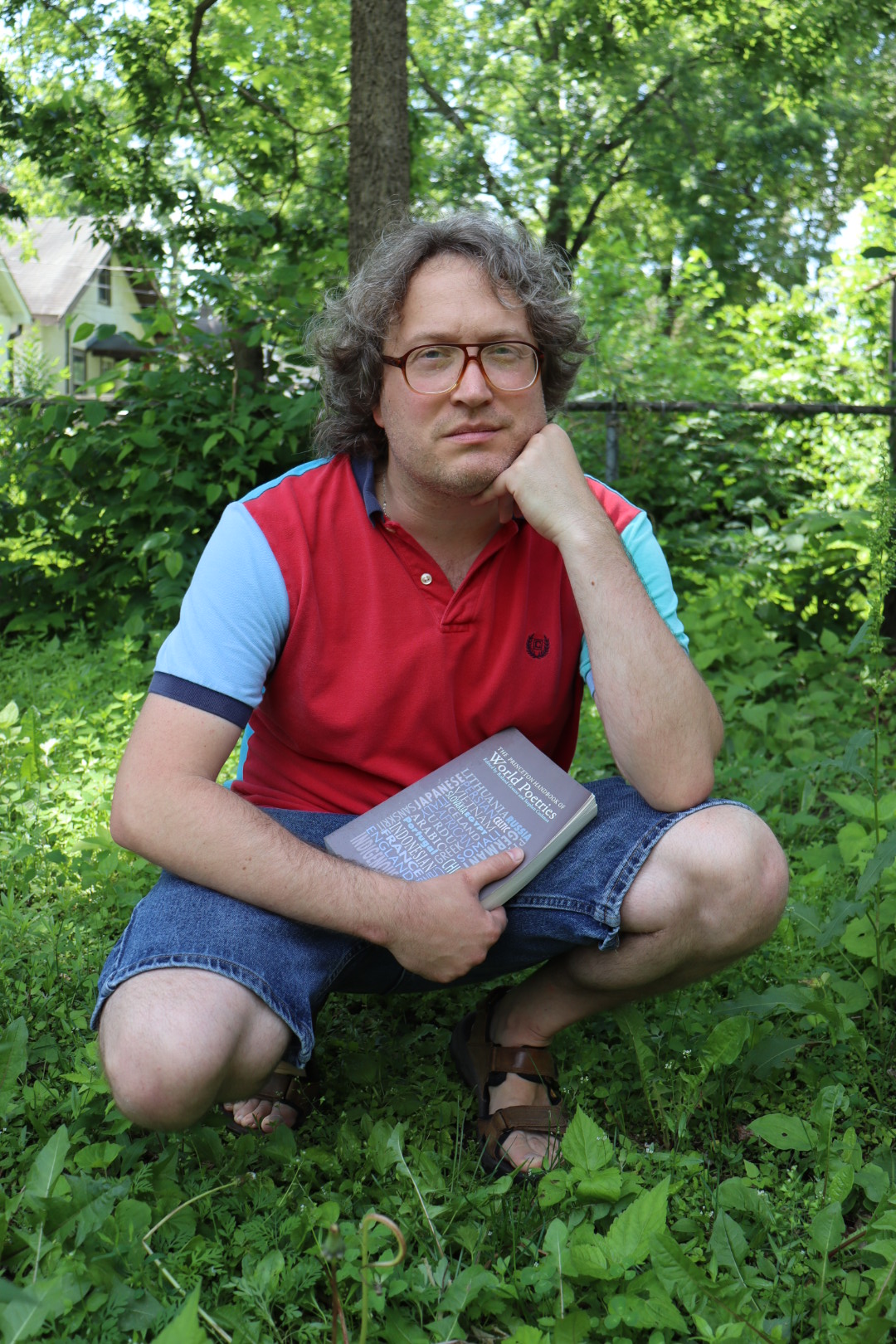
Michael Hessel-Mial teaches university writing at the University of Minnesota. His previous poetry work was in digital image macros, which appeared at Columbia Journal, The Fanzine, Queen Mob’s Teahouse, and elsewhere. Michael’s current interests are in science fiction poetry narratives of class struggle. He invents or repurposes alien forms that reflect the ideology of interstellar class society.