On Knowing Your Endings
By Timons Esaias
Published August 2, 2026
I teach the writing of fiction (and non-fiction, for that matter), and so I have to talk about endings all the time. Because I like to read both literary and popular fiction, and like to write both kinds of stories, I never thought much about the types of endings I was using. I put what seemed to me to be the appropriate ending on the story I was writing, and that was good enough.
And that’s still the advice I give: write your story, and give it the ending that appeals to you. Make it sing.
But when you come to market the thing, there’s something you need to know. Different readerships (genres, if you will) have different expectations for how a story comes out. Editors are attuned to that expectation, and if your story doesn’t match it, you might have trouble.
Let me describe how I came to be clear about this.
Primarily I write both Literary Fiction and Science Fiction. I have always vaguely understood that Literary Fiction likes downbeat endings and status quo endings, and that Science Fiction likes more upbeat endings. But I was quite aware of exceptions to this tendency—some of my favorite SF pieces are tragic or sad—so I didn’t think about it much at all.
But then I had to teach a workshop that would touch on this, and I don’t like to give students vague, untested generalities. I learned long ago that many of the truisms that writers and editors tell each other aren’t really founded in truth. Or maybe they were true twenty years ago, but tastes have changed.
When I’m going to make an assertion in a classroom, I like to have solid numbers. The subject was the endings of Literary stories, and I decided to do what I call a Field Recon. I took the edition of Best American Short Stories that I happened to be reading at the time, and I scored the endings for being upbeat, downbeat, or status quo. Twenty stories is a decent sample size.
The outcome was both expected and a little surprising. Only one of the twenty stories, 5%, had an upbeat ending. A second story had a very slight uptick at the end, so it wasn’t exactly status quo. So, at most, 10% could be classed as positive. The rest were evenly divided between downbeat and status quo. 45% each. That was a much heavier skewing than I would have expected.
It occurred to me then that I should test the Science Fiction side of the comparison, as well. I had already read the Gardner Dozois The Year’s Best Science Fiction anthology for the same year as the Best American. The Dozois anthologies tended to have around 35 stories, so it was a bigger sample size, though still being a single editor’s choice. Again, I was surprised at the extreme skewing: 85% of the stories were upbeat. The remaining 15% was split between status quo and tragic.
And before you even ask if there’s any practical value in knowing this information, I can tell you that it paid off for me very quickly. As I was producing the numbers, I had the thought that I should look at the stories of mine that had been on the market for a while, to see what they were. And guess what? The stories I was having trouble selling were Science Fiction stories with downbeat endings or Literary pieces with upbeat endings.
Because I often write very close to the genre dividing line, all but one of those stories could be marketed on the other side. I sent the downbeat stories to Literary markets and the upbeat stories to the Science Fiction markets, and they all sold within the next few months.
But that left one outlier story, an SF piece with an ending of hopelessness. It was too SF to be marketed elsewhere. That story stayed on the market for ten years, the editors holding it for six months average and then turning it down. My critique group had told me that this might be the best thing I’d ever written, so I didn’t lose faith or change a word, but it was on the market for ten years. Ten years.
Then Analog Science Fiction & Fact changed editors, and I realized I should send something to say hello. All I had was that downbeat story, which I’d never sent to Analog because it most certainly wasn’t a match for their tastes. So I sent it anyway, just as a calling card, and started working on a story that was intentionally more to their taste. But they took the thing, and once it was in print three Best-of-the-Year anthologies came calling for it. And one of those three editors was Gardner Dozois, who had rejected the story for his magazine.
Here’s how I unpack the lessons of all this. First, it is useful to know what the readers and editors of the markets you’re trying to sell to are expecting in their endings. The way to find out is to get some issues of the magazines, or the Year’s Best anthologies, and actually count. (This is also useful for beginnings, POV and tense choices, and on and on.) If you’re trying to increase your sales, it’s best to conform to their standard.
Second, be alert for the possibility of marketing outside your usual list of markets, if you’re writing against type.
Third, if you’ve written the non-standard ending for your genre, be patient and persistent. Keep the dang thing in circulation until you find that editor who is looking for “something different” to balance out an issue. It’s often the outlier story that becomes the center of attention, once it’s in print. (Think about the persistence of “The Cold Equations” and “Flowers for Algernon” as examples.)
An additional targeting tidbit: In 2015 the Best American publishers started a Science Fiction & Fantasy series, of which I’ve read the most recent few issues, and their endings don’t match the numbers I’ve described above. Has the pandemic darkened the genres? Is the world nothing but despair? Well, no. It seems that the editors of this series are looking primarily at “literary” examples of SF&F, so the numbers are probably not typical of the genre as a whole. Typical of this series is something more like 40% upbeat, 30% status quo, 30% downbeat.
I may not be able to fully explain this difference from my expectations, but I certainly know how to use it. I’m making a list of the markets that took the more Literary endings, and keeping it available for when I’m marketing SF with those endings.
I’ve done the same thing on the Literary side: made a list of the markets that took stories with upbeat endings. They’ll be top choices when I have that kind of Literary piece.
To summarize:
- It’s wise to be aware of the favorite ending trajectories for your type of story.
- Learn this by actual counting, not by rumor.
- If you write against type, collect lists of the markets that accept minority outcomes.
- Remember to consider marketing your piece outside your genre, if necessary.
I’ll end by suggesting two writing exercises.
First, go through your own finished pieces, and find out how your stories have been coming out. Upbeat endings? Back-to-zero endings? Tragic endings? Armageddon? Heat death of the Universe? I suggest this simply because it’s good to be self-aware.
Second, take a few of your stories and rewrite the endings so that they take a different trajectory altogether. Victories instead of tragedy, or defeat instead of success. Maybe what was a definitive outcome instead boils down into right where the whole thing started.
When you do these rewrites, try to make them better than the original.
Why do I suggest this? Mainly to remind you (as I remind myself when I do it) that you are supposed to be in charge, not the story. Also, there’s an interesting trick hidden in this exercise. Let’s say you do make the new story better than the original. Well, now you’ve got two stories. You send the better one out there to the magazines, then you take the original one and file the serial numbers off of it (i.e., change the details to the point where no one would know it’s the same story: change era, continent, gender and age of the main character, alter the Macguffin, put different wallpaper in the main hall) and send it out too.
This is not cheating, it’s learning the craft of storytelling.
AUTHOR BIO
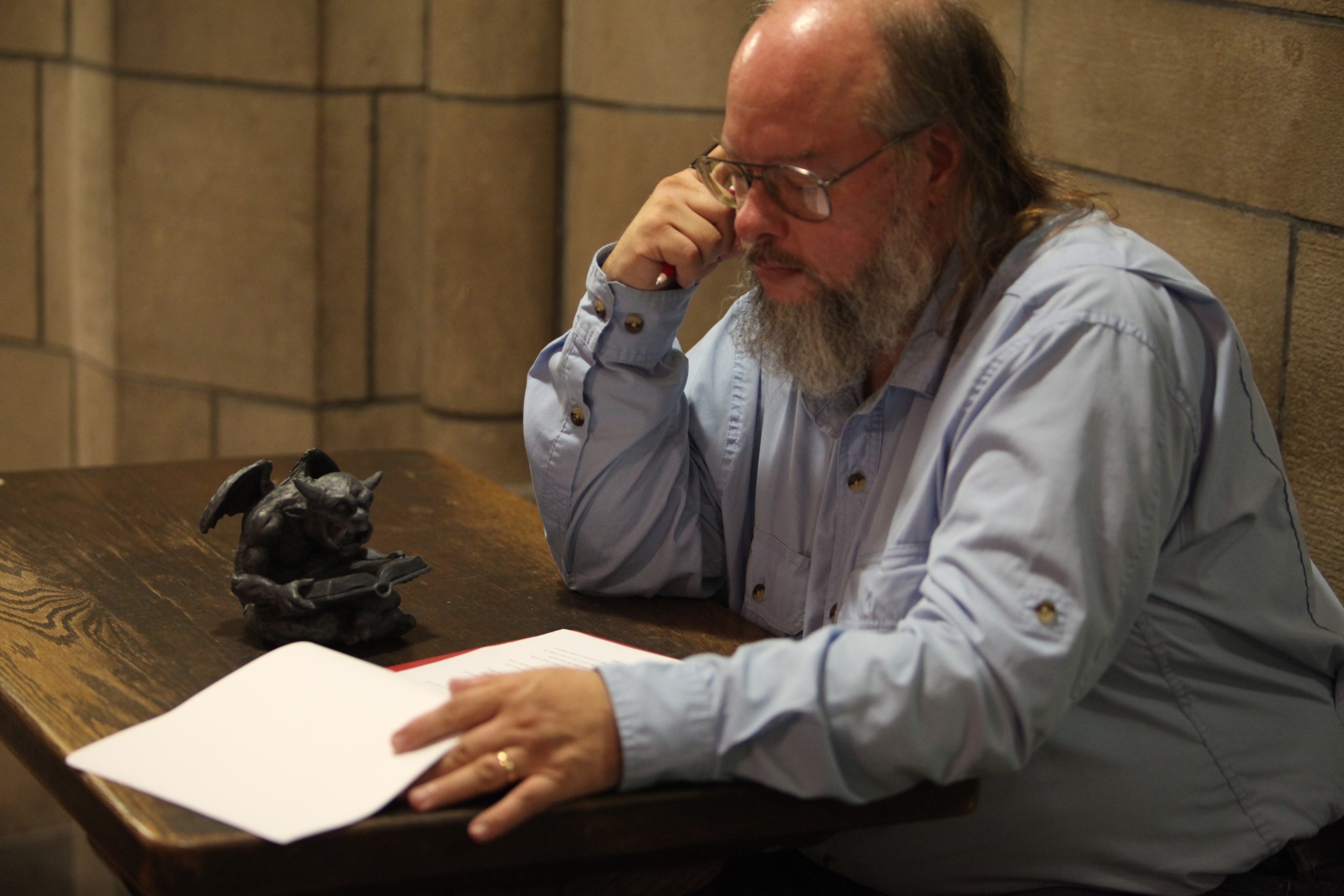
Timons Esaias is a satirist, writer and poet living in Pittsburgh. His works, ranging from literary to genre, have been published in twenty-two languages. He has been a finalist for the British Science Fiction Award, and he won the Winter Anthology Contest, the SFPA Poetry Contest, and the Asimov’s Readers Award (twice). He is a recent Pushcart nominee and Intrepid Award winner for the story “To Do.” He is widely deplored for using a pillow as a protagonist, and, in another story, Concord grape jelly packets as an antagonist. His poetry collection is Why Elephants No Longer Communicate in Greek.