A Gateway to Other Worlds, Other Minds
By Deborah L. Davitt
Published September 6, 2026
I’m on record in a number of forums for saying that the way we have taught poetry in the United States in most schools, going back to the 90s when I was in high school, is just about a crime. Teachers have a tendency to teach poetry as something that shouldn’t be touched, except maybe by white-gloved docents; it should be kept under glass, in a museum. Studied, thought about, but not felt or really enjoyed, except by aesthetes. It’s relegated poetry to a status like that of wine—in which you’re expected to have tasting notes and a carefully cultivated palate, and, certainly, the budget with which to develop those things. Not to bury the lede here, but I believe speculative poetry can—and should!—be used by educators to counteract that tendency. What are current methods of teaching poetry like, and what can speculative poetry do better?
While I’m indebted to my AP English teacher, the late Mel Shields, for having taught me the gentle art of close reading in my senior year of high school, which stood me in good stead throughout college and grad school, I believe that some other parts of his methodology—which included asking the classroom which of two stories in our classroom anthology was “better.” One, “The Most Dangerous Game,” was more genre, certainly; the other, I can’t even remember the title of, some 30+ years later, was certainly more literary, and was the one we were supposed to choose as “better.” I dissent strongly from this false paradigm; if it was better, surely I could remember something about it, these many years since?
He also brought in poetry written by some songstress of the 80s to make fun of the vapidness of the verse. In retrospect, I . . . strongly disagree with this methodology, too. It might not have been deathless poetry, but she clearly had an ability to connect with people’s hearts in song. I don’t know if she wrote her own lyrics (a lot of singers didn’t, at that point in time), but if someone enjoyed her words, and came to poetry through that, why is that wrong?
All of these tendencies are a disservice to students, and I do strongly believe that we need gateways to poetry that people can engage with. Whether that’s through rap lyrics or genre poetry—particularly speculative poetry—we need to catch people’s interest without setting them up to believe that poetry is necessarily difficult and onerous to read (though certainly, some is!), that it’s only for the elite (or the effete), or whatever other falsehoods float out there.
How can speculative poetry help with this? For starters, it deals with familiar topics and tropes. Students are immersed in science fiction and fantasy these days, from Marvel movies on down. These kids grew up reading Percy Jackson books, or watching the Hunger Games movies. They watched Dinosaur Train or Jurassic Park cartoons, or both. They have a speculative vocabulary already built in!
With that vocabulary in place, rhyme and metaphor and all the other tools of poetry should become less scary for them as they approach a speculative poem about intelligent dinosaurs or aliens, say, than if they were approaching a poem about, oh, a poem suffering a laudanum dream in the 19th century. That way, they could engage with the tools without the subject and context being a barrier—and I am all about removing barriers for people as they learn to enjoy new things.
For me, this is like learning to taste a new cuisine. You ideally want a friend who’s familiar with it to go with you to the restaurant to explain what all the words on the menu mean and nudge you towards the things that they like to start with. You might start with something that incorporates familiar elements from your own established palate—hey, those look like tortillas! I like tortillas! Taco Tuesday, am I right? And the next thing you know, you’re eating chapati filled with chicken xacuti from Goa, and enjoying it!
Now, there’s a few steps between reading a poem about intelligent dinosaurs in space and tackling The Canterbury Tales. But . . . to build enjoyment in a thing, and encourage people to try something that’s outside of their previous habits, we have to reach them where they are at the start. That means finding their comfort level (not too much spice, please!) and challenging them, little by little, along the way.
And because speculative poetry is endlessly imaginative and can touch people’s hearts and minds. . . and because the poets working in the field engage with it in traditional forms as well as free verse, I think it’s an ideal place to use as the gateway, not just to other worlds, but to other people’s minds. The minds of poets long dead and gone, and with whom students so often have trouble interacting. The minds of people out there in the world today, who have different perspectives and backgrounds to the students in our schools—or who might share the same backgrounds as those kids, and whose words might resonate with them.
Share this column with your local educators. Make a list of favorite speculative poems and send it to your school board. SWFA (the Science Fiction and Fantasy Writers Association) and SFPA (the Science Fiction and Fantasy Poetry Association) are planning a poetry initiative for AWP attendees, to give them thoughts on what they could add to their curriculum. Let’s change how we teach poetry, from the ground up—while reaching for the stars!
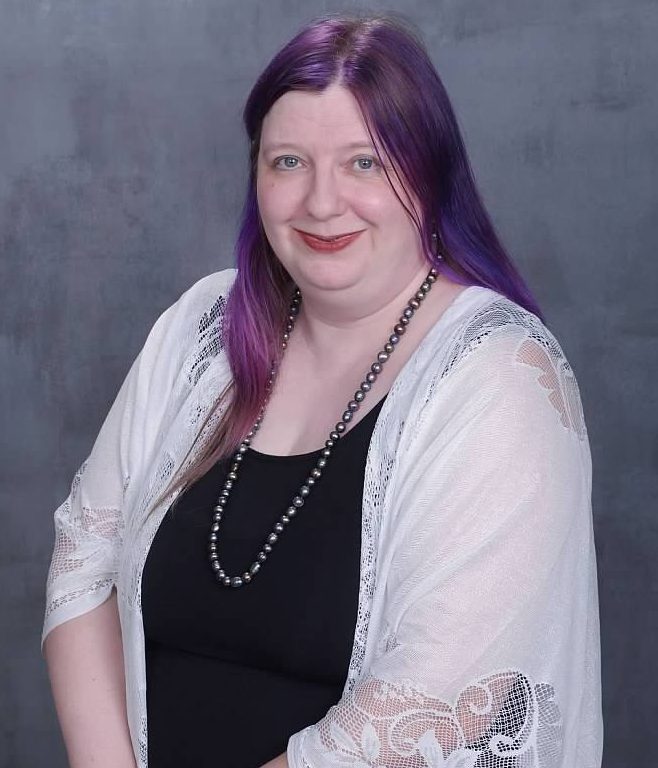
Deborah L. Davitt was raised in Nevada, but currently lives in Houston, Texas with her husband and son. She’s worked as a technical writer on contracts involving nuclear submarines, NASA, and computer manufacturing. Her prize-winning poetry has received Rhysling, Elgin, Dwarf Star, and Pushcart nominations and has appeared in over seventy journals, including F&SF and Asimov’s. Her award-winning short fiction has appeared in Analog and Lightspeed. She’s published six novels and a TTRPG.
For more about her work, including her Elgin-nominated poetry collections, The Gates of Never, Bounded by Eternity, and From Voyages Unreturning, see www.deborahldavitt.com.